Chief Learning Officer "June" — A New Year, a Different Planning Conversation
As June began developing her organization's 2027 learning strategy, the requests from business leaders were familiar. Sales wanted stronger onboarding, more consistent execution, and better adoption of its selling methodology. Customer Service wanted improved customer interactions, greater consistency across teams, and stronger frontline managers. Both business units were exploring how artificial intelligence could improve productivity, accelerate employee development, and help their teams adapt to changing expectations.
The initial planning requests looked much like those from previous years. Each business unit had identified training priorities, potential technology investments, and programs it wanted L&D to support. June's team could have organized those requests into an annual calendar, estimated development costs, allocated resources, and established a delivery schedule.
But June had become increasingly convinced that a traditional training plan was no longer sufficient.
Sales and Customer Service were operating in environments where information was becoming easier to access, customer expectations were increasing, and AI was changing how employees prepared for and performed their work. The challenge wasn't simply keeping employees informed. It was ensuring they could continuously develop and apply the human skills required to perform as the business evolved.
For 2027, June wanted to build something more valuable than a learning calendar. She wanted a strategy that connected business priorities, critical skills, realistic practice, manager coaching, and measurable performance improvement.
Her objective was to move from planning training programs to building Sales Skill Agility: the organizational ability to continuously develop, reinforce, and adapt the selling and customer-facing skills required for consistent performance.
Start With Business Performance, Not the Training Calendar
Annual learning planning often begins with collecting requests from business leaders. Departments identify their priorities, L&D evaluates available resources, and the organization builds a portfolio of programs around its budget and capacity. While that process creates structure, it can also reinforce an assumption that every performance challenge should be addressed through additional training.
June wanted her 2027 planning conversations to begin somewhere different.
Instead of asking Sales and Customer Service leaders what training they needed, she asked what they needed their teams to do better. The distinction changed the conversation from learning activities to business execution.
For Sales, priorities might include improving discovery, navigating complex buying groups, handling competitive objections, expanding existing accounts, or increasing the effectiveness of frontline coaching. For Customer Service, the priorities might include improving first-contact resolution, managing escalations, demonstrating empathy, identifying customer needs, or creating more consistent experiences across channels.
Each priority required a clear understanding of the behaviors associated with successful performance.
June introduced five questions to guide planning discussions:
- What business outcomes matter most in 2027? Identify the revenue, retention, customer experience, productivity, and operational objectives that matter to leadership.
- Which employee behaviors most directly influence those outcomes? Define what effective execution looks like in real customer interactions.
- Where are the greatest capability gaps today? Examine differences between expected and observed performance across roles, teams, regions, and experience levels.
- What prevents employees from performing consistently? Distinguish skill gaps from process, technology, motivation, management, and environmental challenges.
- How will we know capability has improved? Establish measurable indicators of skill development alongside relevant business performance metrics.
These questions positioned L&D as a strategic partner in business performance rather than a function responsible primarily for fulfilling training requests.
Sales and Customer Service Share a Critical Development Challenge
Although Sales and Customer Service operate against different business objectives, June recognized that their capability challenges were increasingly connected.
Both functions depend on employees who can communicate effectively, understand customer needs, navigate difficult conversations, exercise judgment, and adapt their approach in real time. Both rely on frontline managers to reinforce behaviors, provide feedback, and develop performance. Both face pressure to improve productivity while delivering more personalized and effective customer interactions.
AI makes this connection even more important.
Salespeople can use AI to research accounts, prepare meeting briefs, draft communications, and analyze customer information. Customer service representatives can use AI to retrieve knowledge, summarize interactions, recommend responses, and resolve routine issues more efficiently.
Those capabilities can improve productivity, but they don't automatically strengthen the human skills required when an interaction becomes complex.
A salesperson still needs to recognize an unspoken objection, build trust with a skeptical buyer, and adjust a discovery conversation when new information emerges. A customer service representative still needs to de-escalate frustration, communicate with empathy, diagnose an unusual problem, and exercise judgment when the standard process doesn't fully address the customer's needs.
For June, the implication was clear. The 2027 strategy needed to strengthen the capabilities employees bring to customer interactions, not simply improve their access to information.
Priority capabilities across customer-facing business units
|
Capability
|
Sales application
|
Customer Service application
|
| Discovery & listening |
Uncover buyer needs and priorities |
Diagnose customer issues and expectations |
| Communication & empathy |
Build trust and influence stakeholders |
Build rapport and manage frustration |
| Problem-solving & judgment |
Navigate objections and complex decisions |
Resolve nonstandard issues and escalations |
| Adaptability |
Adjust to buyers, markets, and products |
Respond to changing needs and situations |
| Manager coaching |
Reinforce selling behaviors |
Improve service quality and consistency |
These shared capabilities create opportunities to coordinate development strategy across business units. However, the learning experiences must still reflect the distinct situations, customers, performance expectations, and operational environments employees encounter.
A common capability framework can provide consistency. Role-specific development makes that framework meaningful.
Build a Continuous Development Strategy, Not a Collection of Training Events
As June moved from identifying priorities to designing the 2027 strategy, she recognized another weakness in the traditional planning process. Learning investments were often organized around individual programs rather than a connected system for developing capability.
Sales onboarding might be managed separately from sales methodology training. Customer service training might focus on new products or processes without connecting those experiences to frontline coaching. Managers might receive leadership development but have limited visibility into the specific skills their teams needed to improve.
Each program could be effective individually while the broader organization continued struggling with inconsistent execution.
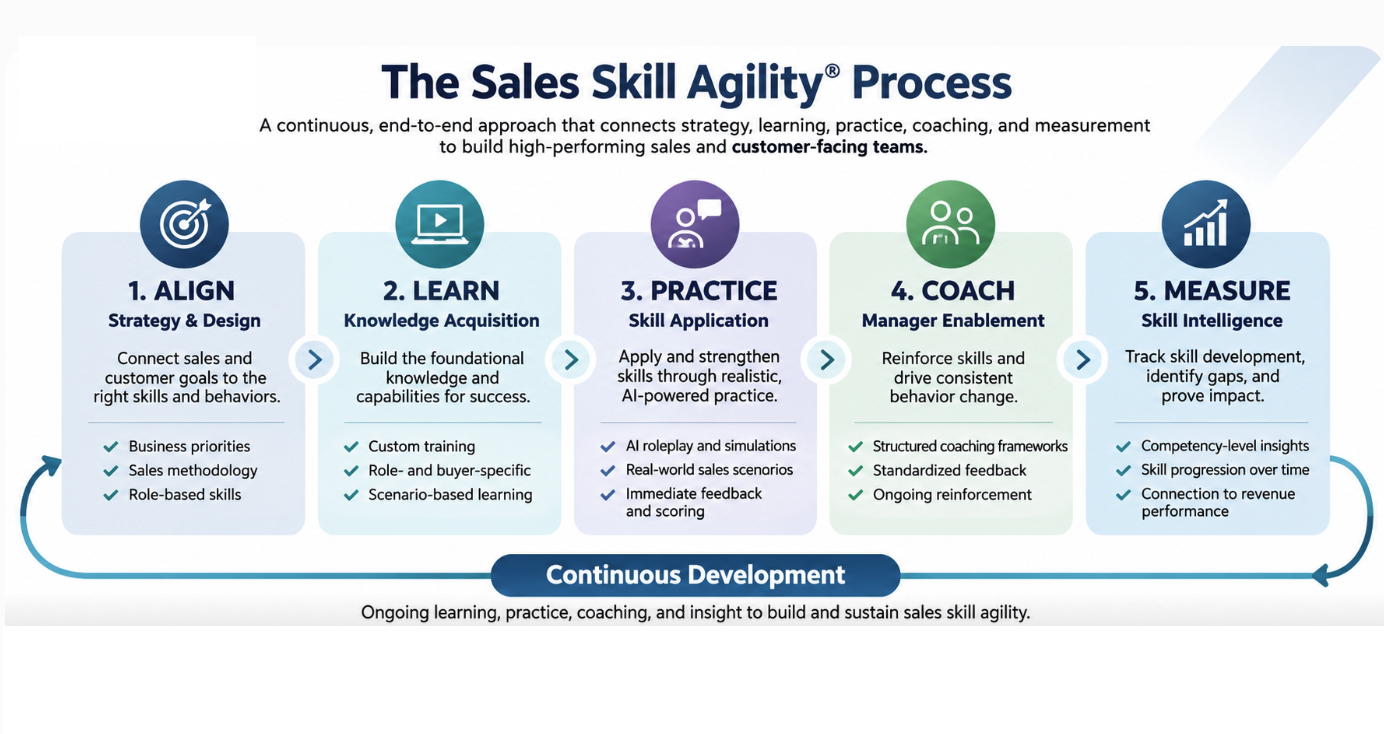
June wanted to connect those investments through a continuous capability development model. The approach aligned closely with the principles of Sales Skill Agility, connecting strategy, custom learning, AI-enabled practice, coaching, and skill measurement rather than treating training as an isolated event.
Unboxed
Her planning framework included five interconnected components:
- Strategy and Skill Definition: Align critical skills and expected behaviors to business objectives, customer interactions, and role requirements.
- Knowledge Acquisition: Deliver relevant, role-specific learning aligned to products, processes, customers, and performance expectations.
- Skill Application: Provide realistic opportunities to practice conversations, make decisions, receive feedback, and improve.
- Manager Enablement: Equip frontline leaders with consistent coaching frameworks, observable skill criteria, and practical reinforcement tools.
- Skill Intelligence: Measure skill progression, identify development gaps, and use those insights to continuously improve the learning strategy.
The advantage of this approach is that development doesn't end when employees complete a program. Knowledge is reinforced through practice, practice informs coaching, coaching supports workplace application, and measurement identifies where additional development is needed.
For June, the annual plan was no longer a list of programs to deliver. It was a roadmap for building and sustaining the capabilities the business would need throughout 2027.
Make AI-Powered Practice a Core Part of the 2027 Strategy
One of June's most important planning decisions involved artificial intelligence.
Business leaders were already exploring AI for productivity, and L&D had begun using it to accelerate content creation. But June believed the larger opportunity for Sales and Customer Service was using AI to help employees develop the skills required for complex customer interactions.
Traditional training can explain a sales methodology or demonstrate how to manage a difficult customer conversation. Employees may understand the concepts and perform well on knowledge assessments, yet struggle to apply those behaviors when the situation becomes unpredictable.
Practice helps close that gap.
AI-powered roleplay allows employees to engage in realistic conversations, respond to changing circumstances, receive feedback, and repeat the experience. Instead of relying exclusively on occasional classroom exercises or live customer interactions, organizations can create more frequent opportunities for skill development.
For Sales, this might include practicing discovery, objection handling, negotiation, competitive positioning, and executive-level conversations. For Customer Service, scenarios might involve frustrated customers, complex escalations, service recovery, or situations requiring empathy and sound judgment.
The key is relevance. Generic simulations may help employees become familiar with a skill, but meaningful development requires scenarios that reflect the organization's actual customers, products, challenges, and performance expectations.
June also recognized that practice should be aligned to defined competencies. Employees need to understand which behaviors they're developing, what good performance looks like, and how their progress will be evaluated.
AI makes scalable practice possible. A thoughtful learning strategy makes that practice valuable.
Put Frontline Managers at the Center of Skill Development
As June reviewed previous learning initiatives, she noticed that the most persistent capability gaps often appeared after formal training ended.
Employees completed onboarding, attended workshops, and demonstrated an understanding of new concepts. Yet the consistency with which those behaviors appeared in customer interactions varied significantly across teams.
The difference frequently involved frontline management.
Sales and Customer Service managers influence employee performance through everyday coaching, feedback, observation, and reinforcement. They establish expectations, identify development opportunities, and help employees translate learning into real-world execution.
However, managers are often promoted because they performed well individually, not because they have been systematically prepared to develop the capabilities of others.
June made manager enablement a central component of her 2027 strategy.
That required more than providing managers with coaching templates or encouraging more frequent one-on-one meetings. Managers needed a shared understanding of the competencies employees were expected to demonstrate, practical methods for observing those behaviors, and structured frameworks for delivering actionable feedback.
Her strategy focused on three priorities:
- Coaching consistency: Establish common skill definitions, observable behaviors, and feedback criteria across managers and teams.
- Coaching effectiveness: Help managers diagnose skill gaps, conduct developmental conversations, and reinforce behaviors through ongoing practice.
- Coaching visibility: Connect learning and practice insights to manager coaching so development conversations are informed by evidence rather than general impressions.
AI could support this process by providing insight into practice performance and identifying recurring skill gaps. Managers could then use those insights to focus their time on the behaviors most likely to benefit from reinforcement.
For June, this was an essential planning principle: if the organization expected sustained behavior change, manager enablement couldn't be an optional component of the learning strategy.
Measure Capability Development Alongside Business Performance
One of the most difficult parts of annual learning planning is demonstrating the business value of L&D investments.
Traditional learning metrics provide important operational visibility. Completion rates, participation, satisfaction, and assessment scores help organizations understand whether employees are engaging with development programs.
But those metrics don't necessarily establish whether employees have become more capable.
June wanted her 2027 strategy to create a clearer connection between learning investments, skill development, and business outcomes.
For Sales, that meant evaluating improvements in critical selling competencies alongside measures such as conversion rates, sales cycle progression, pipeline quality, and revenue productivity. For Customer Service, it meant understanding how communication, problem-solving, and service recovery capabilities related to customer satisfaction, first-contact resolution, escalation rates, and retention.
The important distinction was between measuring business outcomes and understanding the capabilities that contribute to those outcomes.
Revenue and customer experience metrics are influenced by many factors, including market conditions, pricing, product quality, processes, and customer behavior. L&D cannot assume that improvements in those metrics were caused exclusively by training.
However, organizations can develop stronger visibility into whether employees are improving specific capabilities and investigate how those improvements relate to business performance.
That requires a more connected measurement strategy:
- Establish baseline skill proficiency before development begins.
- Define observable behaviors associated with successful performance.
- Measure skill progression through practice, assessments, coaching, and workplace observation.
- Compare capability trends across teams, roles, and experience levels.
- Examine relationships between skill development and relevant business KPIs.
- Use the findings to refine learning priorities and development investments.
This approach moves the conversation beyond reporting learning activity toward building Skill Intelligence: a clearer understanding of workforce capability and how it changes over time.
Turn the 2027 Learning Strategy Into an Executable Roadmap
With priorities established, June faced the practical challenge of translating the strategy into an achievable annual plan.
She knew the organization couldn't redesign every program, address every skill gap, and implement every new technology simultaneously. A successful strategy needed clear priorities, defined ownership, realistic milestones, and a manageable approach to implementation.
Rather than spreading resources evenly across business units and programs, June proposed a phased roadmap.
Illustrative 2027 capability development roadmap
-
Assess & Align: Validate business priorities, assess current programs, define critical skills, and establish baseline capability measures.
-
Design & Pilot: Modernize priority learning experiences, pilot role-specific AI practice, and introduce structured manager coaching.
-
Scale & Reinforce: Expand successful approaches across teams and regions, integrate reinforcement into workflows, and track skill progression.
-
Measure & Optimize: Evaluate capability growth, examine business performance relationships, refine programs, and establish priorities for 2028.
The roadmap also required decisions about the organization's existing learning ecosystem. June's team needed to determine which content should be retained, modernized, or retired; how new practice experiences would connect to existing platforms; what managers needed to support adoption; and which measurements could realistically be established.
Not every business unit required the same level of investment. A sales organization struggling with methodology adoption might prioritize scenario-based practice and manager coaching. A customer service organization experiencing inconsistent escalation handling might focus on role-specific simulations, performance support, and structured feedback.
The objective wasn't to launch the greatest number of initiatives. It was to establish a practical sequence of investments that would produce meaningful improvements in capability.
The 2027 Planning Opportunity: From Learning Provider to Performance Partner
As June prepared to present the strategy to executive leadership, she realized that the most important change wasn't a new program, platform, or AI capability.
It was the way L&D was defining its contribution to the business.
Her 2027 strategy still included custom training, onboarding, digital learning, AI-powered practice, manager development, and learning technology. Those investments remained necessary, but they were no longer disconnected activities competing for attention and budget.
They were components of a coordinated effort to improve how employees performed.
For Sales, that meant developing sellers who could apply their methodology consistently, navigate increasingly complex buying situations, and adapt as products, markets, and customer expectations changed.
For Customer Service, it meant developing employees who could resolve problems effectively, demonstrate empathy, manage challenging interactions, and deliver consistent experiences even as technology transformed routine service work.
Across both business units, it meant creating an organization capable of continuously identifying, developing, reinforcing, and measuring the human skills required for performance.
That was the larger opportunity behind Sales Skill Agility.
June wasn't simply preparing the organization for another year of learning programs. She was helping it build a more adaptable, capable customer-facing workforce.
And as 2027 approached, that felt like a much more valuable strategy.
Key Takeaways
The most effective 2027 learning strategies will begin with business performance rather than training requests. L&D leaders should work directly with Sales and Customer Service executives to identify the capabilities that influence revenue, customer experience, retention, and operational effectiveness. Those priorities should determine which learning investments receive attention and resources.
Sales Skill Agility requires a continuous approach to development. Custom training and onboarding establish knowledge, but sustained performance improvement also depends on realistic practice, structured manager coaching, ongoing reinforcement, and measurable skill progression. AI creates new opportunities to scale those experiences, particularly for complex customer-facing interactions that historically relied heavily on learning through real-world experience.
The strategic value of L&D will increasingly depend on its ability to connect capability development to business outcomes. Learning activity remains useful to measure, but organizations need greater visibility into what employees can actually do, where critical skill gaps exist, and how development investments influence performance. A well-designed 2027 strategy should create both an actionable roadmap and a stronger foundation for measuring workforce capability.
Planning Your 2027 Learning Strategy
Building Sales Skill Agility begins with understanding which capabilities matter most to your business and where your current learning strategy may be falling short.
Unboxed works with enterprise organizations to assess learning ecosystems, align development priorities to business strategy, design custom training experiences, and connect AI-powered practice, manager coaching, and Skill Intelligence into a continuous approach to capability development.
Explore Unboxed Strategic Learning Consulting and Sales Skill Agility and Sales Enablement to learn how to turn your 2027 learning priorities into a practical, measurable development strategy.