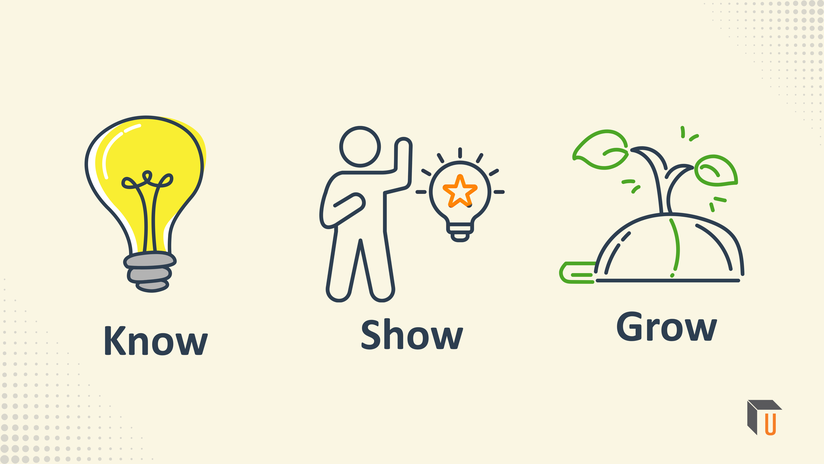
Simon Sinek’s Golden Circle framework challenged leaders to rethink how they communicate: start with purpose, then move to process, then action. While it’s most often applied to leadership and branding, the same thinking offers a powerful lens for employee learning — especially in organizations struggling to turn training into behavior change.
Too often, training begins with content. Policies. Processes. Skills. Sometimes even best practices. What’s missing is meaning.
At Unboxed, we see this play out repeatedly. When learning lacks context, it becomes something employees complete rather than something they use. That’s why we design learning as a continuous cycle: Know, Show, Grow — and why story sits at the center of that cycle.
Know: Knowledge Needs Context to Stick
Knowledge acquisition fails when learners don’t understand why it matters in their world.
In effective learning, knowledge isn’t introduced in isolation. It’s embedded in a situation learners recognize:
- A decision that carries risk
- A moment of tension or uncertainty
- A problem they’ve already faced
Story provides that context. A short scenario or realistic challenge gives information something to attach to. Instead of memorizing facts, learners build understanding around when and why that knowledge applies.
Without context, knowledge fades. With it, knowledge becomes usable.
Show: Practice Is Where Learning Becomes Skill
Most training shows learners what “good” looks like. Far less lets them practice getting there. Even fewer provide learners with a safe place to fail; and try again.
In the Show phase, learning shifts from information to action. Narrative-based practice creates space for learners to:
- Make choices, not just follow steps
- Navigate tradeoffs, not ideal scenarios
- Experience consequences without real-world risk
This is how people actually learn to perform. Skills aren’t built by observing perfection; they’re built by making decisions, seeing outcomes, and adjusting.
When practice is grounded in story, learners don’t just rehearse behaviors — they develop judgment.
Grow: Feedback Turns Experience Into Improvement
Learning doesn’t end with practice. Growth happens through feedback and coaching.
In the Grow phase, story-based learning supports:
- Clear debriefs tied to the learner’s decisions
- Feedback that explains impact, not just correctness
- Coaching that reinforces what to repeat and what to change
Because the learning experience reflects real work, feedback feels relevant and actionable. Learners can see how their choices led to outcomes — and how different choices would lead to better ones.
This is where continuous learning takes hold. Each cycle builds on the last, reinforcing knowledge, sharpening skill, and accelerating growth.