
Stop Launching Training. Start Building Capabilities.
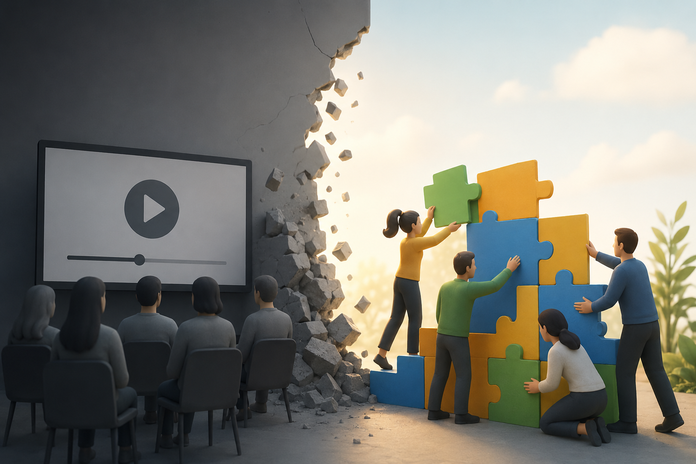


Why Learning Leaders Must Shift from Delivering Content to Building Skill Agility
June never set out to become a Chief Learning Officer.
She started her career as a facilitator.
In her early years, she loved being in the classroom. She loved watching people have breakthrough moments. She loved seeing confidence grow as employees learned new skills and took on new challenges.
Over the next twenty years, she built learning organizations for some of the world's largest companies. She led onboarding transformations. She launched leadership academies. She modernized sales enablement programs. Along the way, she earned a reputation as someone who could build exceptional learning experiences.
And for a long time, that was enough.
Then the world changed.
Digital transformation accelerated.
Customer expectations evolved.
Organizations restructured.
New technologies emerged.
And then AI arrived.
Suddenly, entire roles began changing faster than traditional training programs could keep pace.
The requests coming from the business changed too.
The Chief Revenue Officer wasn't asking for another sales curriculum.
He wanted sellers to have better customer conversations.
The Chief Operating Officer wasn't asking for more leadership training.
She wanted managers who could coach, adapt, and lead through uncertainty.
The CEO wasn't asking how many employees completed training.
He wanted to know whether the workforce was prepared for what came next.
June began noticing a pattern.
Every year, her team created more content.
Every year, employees completed more training.
And every year, executives became less interested in learning metrics and more interested in business outcomes.
One afternoon, after presenting the results of a major leadership development initiative, the COO asked a question that stuck with her.
The program had exceeded every learning metric.
Participation was high.
Completion rates were strong.
Satisfaction scores were excellent.
Yet the COO simply asked:
"So what changed?"
The room went quiet.
June had data on attendance.
She had data on completion.
She had data on learner satisfaction.
What she couldn't easily demonstrate was whether leaders were behaving differently.
Or whether the business was performing differently because of it.
Driving home that evening, she couldn't shake the feeling that something fundamental had changed.
For years, Learning and Development had focused on delivering learning.
The business was now asking for something else.
Capability.
Not courses.
Not content.
Not completion.
Capability.
That realization would fundamentally change how June thought about workforce development.
Because the future wasn't about creating more training.
It was about building the skills, behaviors, and capabilities organizations needed to adapt at the pace of change.
The Problem Isn't Training. Most organizations don't have a training problem. They have a capability problem.
This distinction matters.
When organizations face a challenge, the default response is often to create learning.
Sales performance is declining?
Launch training.
Managers aren't coaching?
Launch training.
Customer satisfaction is dropping?
Launch training.
The assumption is that if people learn something new, performance will improve.
Sometimes it does.
Often it doesn't.
Not because the training was poorly designed.
Not because employees weren't engaged.
But because learning and capability are not the same thing.
Knowledge is important.
But knowledge alone rarely changes behavior.
Anyone can attend a workshop on coaching.
That doesn't mean they become a better coach.
Anyone can complete a course on negotiation.
That doesn't mean they can negotiate effectively under pressure.
Anyone can pass a certification exam.
That doesn't mean they can perform successfully in real-world situations.
Organizations have become very good at transferring knowledge.
What they struggle with is developing capability.
Why This Challenge Is Growing
The pace of change inside organizations is accelerating.
According to the World Economic Forum, nearly 40% of core workforce skills are expected to change over the next five years.
At the same time, organizations are investing billions in digital transformation, AI adoption, workforce modernization, and leadership development.
The challenge isn't identifying what needs to change.
The challenge is helping people adapt quickly enough to support those changes.
Traditional learning models were designed for a different era.
They were built around events.
Courses.
Workshops.
Programs.
Completions.
But today's environment requires something different.
It requires continuous capability development.
It requires organizations to build skills at the pace of change.
This is where Skill Agility becomes essential.
What Is Skill Agility?
Skill Agility is the ability to develop skills at the pace of change.
It is an organization's capacity to continuously identify capability gaps, develop new skills, reinforce behaviors, and adapt as business needs evolve.
Skill Agility recognizes a simple truth:
The skills that made employees successful yesterday may not be the skills they need tomorrow.
Organizations can no longer rely on static learning programs designed once and deployed for years.
Instead, they need systems capable of continuously developing workforce capability.
This requires a shift from thinking about training as an event to thinking about development as an ecosystem.
The Shift from Learning Programs to Capability Systems
The most effective organizations no longer begin with content.
They begin with outcomes.
Before a single course is created, they ask:
- What business outcome are we trying to influence?
- What behaviors drive that outcome?
- What skills enable those behaviors?
- How will we measure success?
Only after answering those questions do they begin designing learning experiences.
This is the foundation of the Skill Agility Framework.
The framework provides a structured approach for connecting business strategy to workforce capability.
Rather than focusing on learning activity, it focuses on performance outcomes.
The Skill Agility Framework
At its core, the framework follows a continuous cycle.
Identify the Skill Gap
Everything starts with performance.
Organizations identify where capability gaps exist between current performance and desired outcomes.
These gaps may emerge from:
- Business transformation
- New technology adoption
- Leadership challenges
- Sales performance issues
- Operational changes
The goal is to understand not simply what people need to know, but what they need to do differently.
Deliver Targeted Knowledge
Once the required skills are identified, organizations provide focused learning experiences aligned to those capabilities.
This is where traditional learning still plays an important role.
Employees need foundational knowledge.
They need frameworks.
They need context.
But knowledge should always serve a purpose.
Learning should prepare people for application.
Not simply completion.
Create Opportunities for Practice
This is where most organizations struggle.
Training often ends precisely when skill development should begin.
Skills are built through repetition.
Application.
Experimentation.
Feedback.
Whether through simulations, role plays, scenario-based exercises, or real-world experiences, employees need opportunities to practice in a safe environment before performance matters.
Practice transforms knowledge into capability.
Provide Coaching and Feedback
Practice generates data.
Data creates insight.
Insight enables coaching.
Managers play a critical role in helping employees refine their skills over time.
The most effective organizations create structured coaching systems that provide:
- Consistent feedback
- Clear expectations
- Development guidance
- Ongoing reinforcement
Because learning may create awareness.
But coaching creates behavior change.
Measure and Refine
Finally, organizations measure progress.
Not simply completion.
Not attendance.
Not satisfaction.
Capability.
Skill development.
Performance improvement.
Business outcomes.
The insights generated through measurement inform future development efforts and identify the next growth opportunities.
The cycle then begins again.
Why Learning Leaders Must Lead This Shift
For years, Learning and Development has been viewed as the organization responsible for training.
That role is evolving.
Today's learning leaders are increasingly responsible for workforce capability.
That means helping organizations answer questions like:
- Are our people prepared for future roles?
- Can managers coach effectively?
- Are employees developing the skills transformation requires?
- Where do capability gaps exist?
- How quickly can we adapt to change?
These are no longer learning questions.
They are business questions.
And they require a different approach.
One focused on capability rather than content.
Performance rather than participation.
Skill development rather than course completion.
The Future Belongs to Capability Builders
A few months after that meeting, June presented to the executive team again.
This time the conversation was different.
No one asked about completion rates.
No one asked how many courses had launched.
Instead, they discussed capability gaps.
Coaching effectiveness.
Skill progression.
Performance outcomes.
Learning had stopped being the destination.
It had become part of a larger system designed to build capability.
And that's the challenge facing every learning leader today.
The organizations that thrive in the future will not be the ones that produce the most content.
They will not be the ones with the largest course libraries.
They will not be the ones with the highest completion rates.
They will be the ones that build skills the fastest.
Because in a world defined by constant change, the ultimate competitive advantage is not knowledge.
It's Skill Agility.