If L&D disappeared tomorrow, how long would it take the business to notice?
That question makes most organizations uncomfortable.
Because the honest answer is often: not immediately (worse, not all).
And that reveals something important.
Fast L&D is not impressive.
It’s often irresponsible.
“Quick launch.”
“Rapid rollout.”
“We stood this up in six weeks.”
Speed has become a virtue signal.
But here’s the uncomfortable truth about speed and learning:
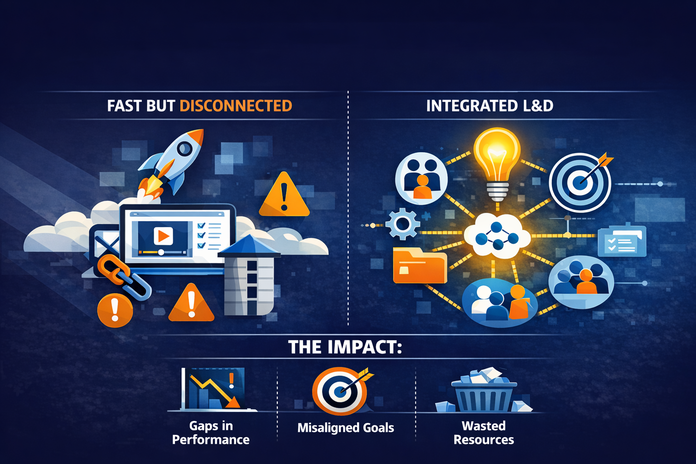
Speed without integration doesn’t build capability.
It builds activity.
And activity is a very convincing illusion.
Most learning initiatives fail at transfer.
Not because the content was bad.
Not because the facilitator lacked energy.
But because the system around the learning never changed.
Research on transfer of training consistently shows that only a fraction of what is learned actually shows up in performance. The common culprits are predictable:
- No manager reinforcement
- No opportunity to practice under real pressure
- No accountability loop
- No alignment to real business friction
Translation:
The organization moved fast to deploy content…
and skipped the slower work of integration.
------------------------------------------------------------------------------------------
What the Research Actually Says
- Brinkerhoff’s Success Case Method shows that only a small percentage of participants typically drive measurable performance improvement after training. The differentiator is not content quality. It is manager reinforcement and opportunity to apply.
- Beer & Eisenstat (Harvard Business School) argue that most leadership development fails because organizations refuse to confront systemic barriers that undermine behavior change.
- ATD’s transfer research indicates that manager involvement before and after training is one of the strongest predictors of sustained performance improvement.
------------------------------------------------------------------------------------------
Fast feels productive.
Integration feels heavy.
Fast gets applause.
Integration requires partnership.
So L&D optimizes for the thing it controls: launch date, content development, completion rate, attendance.
And the business optimizes for the thing it feels: performance under pressure.
When those two aren’t connected, you don’t have speed.
You have drift.
And drift at scale is expensive.
Where This Breaks
Performance follows a predictable curve.
Immediately after training, confidence spikes.
Self-assessments rise.
Energy is high.
Then friction hits.
Deadlines.
Competing priorities.
Managers who were never briefed.
Metrics that reward old behavior.
Without reinforcement, performance does not plateau.
It drops.
Behavioral science calls this the forgetting curve.
In organizational settings, it’s better described as a performance decay curve.
What looked like progress in week one becomes noise by week six.
Not because people resisted.
Because the system absorbed the change and reverted to equilibrium.
Speed accelerates you to the top of the curve.
Integration determines whether you stay there.
If your CEO cannot clearly explain how a learning initiative will change performance, you are at risk.
That’s not an insult. It’s a design flaw.
When L&D operates in “delivery mode,” the implicit belief is:
Our job is to create and distribute learning.
When L&D operates in “partnership mode,” the belief shifts:
Our job is to influence performance.
Those are not the same job.
Delivery mode moves fast.
Partnership mode moves with consequence.
Delivery mode asks:
- How quickly can we build this?
- How many people completed it?
Partnership mode asks:
- What behavior must change?
- Where will that behavior be tested?
- Who must reinforce it?
- What breaks if it doesn’t shift?
The second set of questions slows you down at the beginning.
It speeds you up where it matters.
Because it enables integration.
The Integration Test
Before launching anything, run this three-part test.
Pressure Check
Where will this skill collide with real business friction in the next 90 days?
If you can’t name the moment, you are designing without integration.
Reinforcement Map
Who will observe, coach, or hold accountable for this skill?
If the answer is “the learner,” you skipped the system.
Break Point Analysis
If this initiative works, what measurable shift should the business feel?
Revenue stability?
Faster decision cycles?
Fewer escalation loops?
Reduced rework?
If you can’t describe the consequence, you launched too early.
This isn’t bureaucracy.
It’s discipline.
Speed is seductive because it signals responsiveness.
But responsiveness without structural alignment is illusion.
If L&D disappeared tomorrow, would business performance slow down?
If the honest answer is “not immediately,” the issue isn’t effort.
It’s integration.
Moving fast is not a strategy.
Designing for consequence is.
And that takes nerve.
If this feels uncomfortable, good.
Fast is easy.
Integrated is accountable.
Only one produces capability.