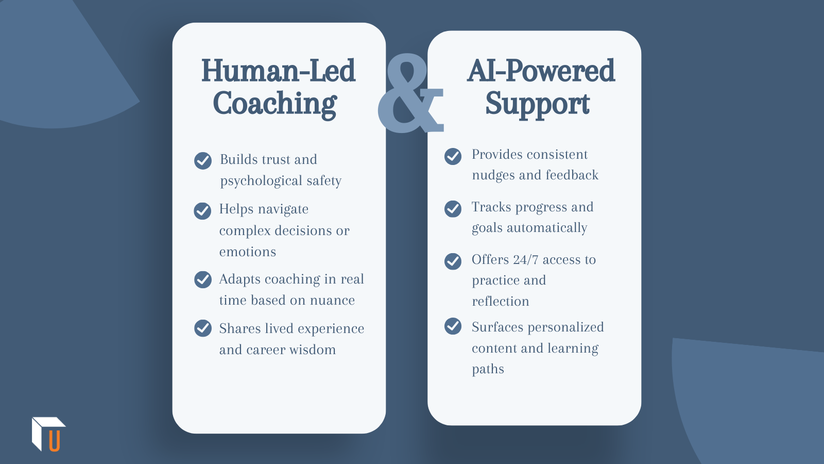
The future of employee development isn’t fully human. And it’s not fully AI.
It’s both.
As organizations face increasing pressure to develop their people at scale, a new approach is emerging—one that blends the emotional intelligence of human mentors with the precision, consistency, and accessibility of AI. This hybrid model of coaching and mentoring is not only possible—it’s essential for driving sustainable performance in the modern workplace.
Don't miss our latest infographic, The Scalability Problem, which reveals why most mentoring models fail to scale—and how forward-thinking companies are solving it.
Why Human-Only Development Isn’t Scalable
Traditional coaching and mentoring models are built on trust, connection, and lived experience. But they weren’t designed for today’s speed of business. Leaders and L&D teams face growing demand to:
- Deliver more personalized development to more people
- Support remote and hybrid teams with equal access
- Reduce burnout among coaches and mentors
- Prove measurable ROI from coaching efforts
These demands expose the limitations of a purely human model. No matter how dedicated your coaches are, they can’t be everywhere at once. And even the most experienced mentor can’t provide round-the-clock support to a distributed workforce.
That’s where AI fills the gap.
Why AI-Only Development Lacks Depth
On the flip side, AI coaching tools offer powerful benefits: they scale instantly, deliver feedback in real-time, and create structure for goal-setting, reflection, and skill practice.
But AI can’t offer empathy, adapt to complex interpersonal dynamics, or share personal stories that build trust.
Without a human component, AI-only coaching and mentoring falls short—especially when navigating high-stakes or emotional challenges like leadership transitions, career planning, or performance struggles.
That’s why the future isn’t AI or human. It’s human with AI.
What a Hybrid Coaching Model Looks Like
In a hybrid model, coaching and mentoring become a coordinated partnership between humans and technology. Here's how it works:
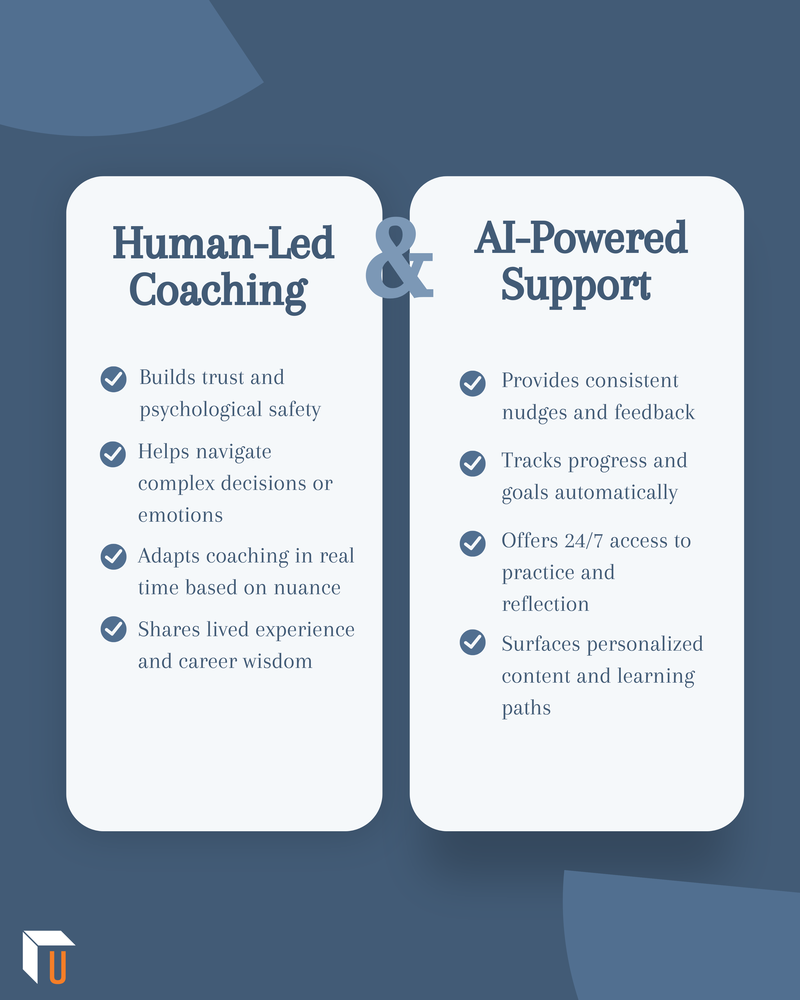
When combined, these approaches reinforce each other. A coach helps an employee define their goals. AI helps them stay on track. The mentor offers perspective on a challenge. The AI offers a safe space to rehearse the next conversation. Together, they create a continuous, supportive growth experience.
Why This Model Works
According to the 2020 ICF Global Coaching Study, organizations that use coaching report improved employee engagement (65%), increased productivity (60%), and stronger leadership (51%). But scaling those benefits beyond a select group has historically been difficult.
That’s changing.
In Deloitte’s 2020 study on AI in talent development, 56% of organizations said they plan to use AI to support coaching and learning programs. Why? Because it enables:
- Scalability – Reach everyone, not just high-potentials
- Equity – Remove access barriers based on geography or role
- Consistency – Deliver a unified experience across teams and time zones
- Efficiency – Automate tasks like scheduling, follow-up, and tracking
But it only works when AI augments—not replaces—the human connection.
What to Look for in a Hybrid Coaching Ecosystem
If you're building a hybrid coaching and mentoring model, here are a few key considerations:
- Tech with a purpose: Choose AI tools that support reflection, practice, and goal-tracking—not just content delivery.
- Integrated systems: Ensure your AI tools work within your existing LMS, LXP, or communication platforms so coaching happens in the flow of work.
- Data without bias: Use AI solutions that are transparent, bias-audited, and designed with ethical safeguards.
- Support for human coaches: AI should take administrative tasks off their plate—not add complexity.
When done right, the result is a culture of always-on development—where employees feel seen, supported, and continuously growing.
How Unboxed Delivers the Best of Both Worlds
At Unboxed, we’ve built our coaching ecosystem to blend the best of human expertise and AI-powered innovation. Our Skill Building Platform supports hybrid development through:
- Mentor™: An AI-powered roleplay and coaching tool that helps employees rehearse key conversations, receive instant feedback, and build confidence—all at scale.
- Spoke®: Our learning engine that integrates compliance training, skills content, and learner journeys—ensuring development is personalized and tracked.
- Custom Coaching Journeys: We work with clients to design development pathways that combine AI practice, human-led sessions, and progress tracking—all in one experience.
Whether you’re upskilling a salesforce, building your leadership bench, or creating a coaching culture across a hybrid workforce, Unboxed gives you the infrastructure to scale without sacrificing the human touch.
Final Thought
The future of coaching and mentoring isn’t about choosing sides—it’s about choosing synergy. AI and humans are better together. In a hybrid model, technology becomes the multiplier that extends your people’s capacity, reduces burnout, and ensures that every employee—not just a lucky few—has the tools and support to grow.