
You Don’t Want a Seat at the Table. You Want to Earn a License to Operate.



The business does not care about training.
Full stop.
It cares about performance.
And when training improves performance, the business pays very close attention.
But L&D often reads this differently.
It sees a lack of interest in training.
A lack of understanding of L&D.
A lack of appreciation for what training can do.
So, the conclusion becomes:
“If we were closer to the business…
If we had a seat at the table…
If we were invited into the conversation earlier…
If leaders understood training better…”
Then it would matter more.
But that’s not what’s happening.
The business is not ignoring training.
It is prioritizing what it is accountable for.
And anything that does not clearly move those outcomes gets deprioritized.
Not dismissed.
Deprioritized.
That distinction matters.
This is where L&D gets stuck.
It chases access.
When it should be chasing relevance.
Because access does not create value.
Relevance does.
You don’t need to be in the room to be relevant.
You need to be connected to what the room is accountable for.
That’s the difference between having a seat at the table and having a license to operate.
A seat is presence.
A license to operate means your work is trusted to influence how the business runs.
Not observed.
Not appreciated.
Used.
L&D spends a lot of time trying to educate leaders about the value of learning.
But leaders already value learning.
They value it when it shows up in the moments they are held accountable for.
When a deal slips.
When a decision stalls.
When a team escalates problems instead of resolving them.
When performance varies wildly across managers.
When results become unpredictable.
Those are not learning problems on paper.
They are operational problems in real life.
And anything that reliably improves those outcomes earns attention very quickly.
That’s what a license to operate looks like from the business’ perspective.
Not more visibility.
Not better messaging.
Not earlier access.
Reliable impact in moments that matter.
And this is where L&D’s credibility is either built or quietly eroded.
If your dashboard reports:
- Completion rate
- Attendance
- Engagement scores
You are measuring activity inside your department.
Not impact inside the business.
You are proving efficiency.
Not influence.
And over time, that pattern teaches the organization something:
Training is helpful.
But not essential.
And once something is seen as non-essential, it gets cut, delayed, or deprioritized when pressure rises.
That’s not a perception problem.
It’s a positioning problem.
And positioning determines whether you’re consulted or bypassed.
L&D needs to translate learning into performance.
Translation is not wordsmithing.
It’s about connecting learning to what leaders are held accountable for.
Here’s the discipline:
Before presenting any initiative to senior leaders, rewrite it in language the business will understand and act on: operational consequence.
For example:
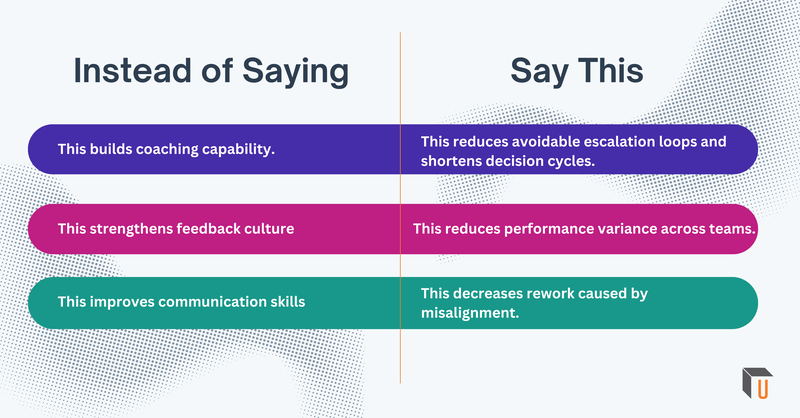
Instead of Saying
Say This
“This builds coaching capability.”
“This reduces avoidable escalation loops and shortens decision cycles.”
“This strengthens feedback culture.”
“This reduces performance variance across teams.”
“This improves communication skills.”
“This decreases rework caused by misalignment.”
If you cannot translate the initiative into operational consequence, you are not ready to present it.
That’s not harsh.
That’s how you earn your license to operate.
So, stop waiting to be invited to the table.
Start earning your license to operate.
By making performance more stable, more predictable, more resilient.
That’s what the business trusts.
And what it values.
------------------------------------------------------------------------------------------
What the Research Shows
McKinsey & Company consistently reports that organizations linking capability building directly to strategic outcomes outperform peers in resilience and long-term performance.
John Kotter’s research on change highlights that transformation fails when urgency is declared but structural reinforcement is weak.
Measurement is not neutral.
What leaders review, they reinforce.
If learning metrics are disconnected from business outcomes, learning will be treated as discretionary.
------------------------------------------------------------------------------------------

