Artificial intelligence has transformed Learning & Development. Today, anyone can generate a course outline in seconds, a facilitator guide in minutes, or a polished eLearning module before lunch. Production speed is no longer the constraint.
But effectiveness still is.
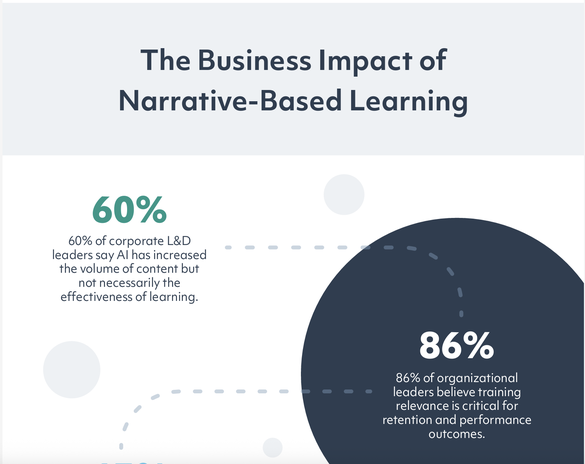
Industry research shows that while AI is dramatically increasing the volume of learning content, impact isn’t automatically improving. Only a small percentage of L&D teams report a strong ability to link training to measurable performance outcomes. Completion rates may rise. Libraries may grow. Yet behavior in the field often stays the same.
The problem isn’t production. It’s transfer.
If behavior change is the goal, content alone isn’t enough. Context is.
If we zoom out across the ideas explored in our recent blogs:
- AI: Everyone Can Create Training Content. Most People Shouldn’t.
- Your Training Isn’t Failing. It’s Being Ignored.
- Why Great Training Starts With Meaning — Not Content
One theme becomes unmistakable: The future of learning does not belong to faster content production.
It belongs to intentional, narrative-based design grounded in real work.
And the data makes that case clearly.
Why Information Doesn’t Change Behavior
Behavioral science is clear: people don’t change because they know more. They change when they recognize a situation, make a decision, and experience consequences.
Abstract instruction — policies, frameworks, bullet lists — removes context. The brain struggles to apply rules without situational cues. That’s why scenario-based learning dramatically outperforms passive instruction for long-term retention, and why learners are significantly more engaged with simulations than with traditional slide-based content.
Story works because the brain encodes patterns, not procedures.
When learning is built around narrative, learners don’t just memorize steps. They develop mental models: who wants what, what constraints exist, what risks are present, and what happens next. Those models transfer when conditions shift — and they always do in real work.
Customization: The Missing Multiplier
In large organizations, generic learning fails fast. Employees immediately know when a scenario isn’t about them:
“That’s not how it works here.”
“Our customers aren’t like that.”
“This feels theoretical.”
Relevance determines engagement. And engagement determines application.
Research consistently shows that learners are more engaged — and organizations see stronger business impact — when training reflects real roles, real language, and real-world constraints. Custom training programs are significantly more likely to drive reported behavior change than off-the-shelf solutions.
Customization doesn’t mean overproduction. It means precision. Real tradeoffs. Real consequences. Real decisions.
If training could apply anywhere, it often applies nowhere.
Where AI Helps — and Where It Doesn’t
AI is not the problem. It’s a powerful accelerator.
It can:
Draft scenario frameworks quickly
Generate branching pathways
Create visual and written assets
Prototype simulations
Support scalable practice environments
But most organizations still require human subject matter experts to vet AI-generated training for contextual accuracy and relevance.
Why? Because AI doesn’t understand your culture. It doesn’t navigate your gray areas. It doesn’t feel your organizational risk tolerance.
AI can generate content. It cannot generate meaning.
Used well, AI frees learning professionals from production mechanics so they can focus on what matters most: identifying critical decisions, designing realistic consequences, and crafting debriefs that translate insight into action.
The future of learning isn’t AI-authored content. It’s AI-enabled intentional design.
Start With Meaning, Not Content
Too often, training begins with information. Policies. Processes. Best practices.
Effective learning begins with purpose.
At Unboxed, we think about learning as a continuous cycle: Know, Show, Grow.
Know: Knowledge embedded in recognizable situations.
Show: Practice grounded in realistic tradeoffs, with space to fail safely.
Grow: Feedback that connects decisions to outcomes and reinforces better judgment.
Story sits at the center of that cycle. It provides the context that makes knowledge usable, practice meaningful, and feedback actionable.
When learners experience consequences — even simulated ones — they begin building the judgment required to perform under pressure.
And that’s the true measure of learning impact.
See the Data: The Business Impact of Narrative-Based Learning
If you’re evaluating how to evolve your learning strategy in an AI-saturated environment, the business case matters.
That’s why we created the infographic:
The Business Impact of Narrative-Based Learning
It brings together the research behind this shift, including:
The rising volume of AI-generated training content — and the effectiveness gap that remains
The engagement advantage of scenario- and simulation-based learning
The link between customization and measurable behavior change
Why relevance is now the #1 driver of learning transfer
In one clear visual, it outlines what forward-thinking L&D leaders are recognizing: in an age of content abundance, contextual narrative design is the differentiator.
If you’re making decisions about AI adoption, training investment, or performance strategy in 2025 and beyond, this infographic provides the data to guide that conversation.
The Business Case for Narrative-Based Learning
If you want a clear snapshot of why narrative-based, custom learning matters now more than ever, we’ve captured the data in one place.
It highlights:
- The engagement advantage of scenario-based training
- The measurable impact of customization
- The limits of AI-generated content without human design
- The growing demand for relevance in modern learning ecosystems